The Destination Test
Why Saving Information Is Not the Same as Building Knowledge
I. The Ghost of Mobile Flash
There are 185 unread items in my feed reader and 342 articles saved in Instapaper. I know both numbers without opening either app. They sit in the margins of my attention, a pair of digital ledgers that only move in one direction.
Last week, I opened two of the saved articles at random. Not to read them, but to run a forensic analysis on what they actually were.
The first was a Mashable piece from November 30, 2012, detailing a workaround to get Adobe Flash running on an iPhone. On paper, the facts were impeccable. In reality, I was staring at a miniature digital cemetery. Adobe had abandoned mobile Flash development in 2011, a year before the article was written. The player itself reached official end-of-life in 2020, and by early 2021, Adobe began actively blocking Flash content from executing at all.
The problem was dead. The workaround was dead. The technology was dead. So was the physical phone I would have run it on.
There are two ways for a saved article to stop mattering, and neither of them is you finally getting around to reading it. I have 340 of these corpses left in the vault.
I used to blame the algorithm. The case against the infinite scroll is easy and mostly true: the modern feed is engineered to keep you looking, not to help you finish. I thought my hoarding was a symptom of a platform designed to feed on my attention. I believed that if I could just build a cleaner, quieter doorway back to the open web, the hoarded backlog would dissolve.
So, I built a door.
II. The Plumbing of the Infinite
I set up Feedly by hand, using empty, deliberately named folders. I chose sixty individual sources—writers I’d followed sideways through other people’s links for years, small sites that operated on the margins of the system. It was a slow, deliberate act of curation. Nothing was inserted by a recommendation engine; nothing arrived that I hadn’t explicitly asked to see.
At the end of the first day, I did something I hadn’t done in years: I scrolled to the very bottom. I watched the unread counter click to zero, closed my laptop on purpose, and felt a clean, specific satisfaction.
That is the quiet promise of RSS. The thing that distinguishes the open web is not neutrality or privacy; it is that it has a bottom. You can reach it. It restores the possibility of being finished.
The honeymoon survived for exactly a week.
The system broke on an ordinary Tuesday. I came home from a heavy day at work, waiting for a specific cognitive window—fifteen or twenty clean minutes, a quiet room, nothing pulling at my attention. The window never came. I didn’t open the reader. By Wednesday, the unread count had climbed back into the double digits.
I had transformed reading into something that required pristine conditions, and conditions are a state of grace you can wait for indefinitely without ever once actively refusing to work.
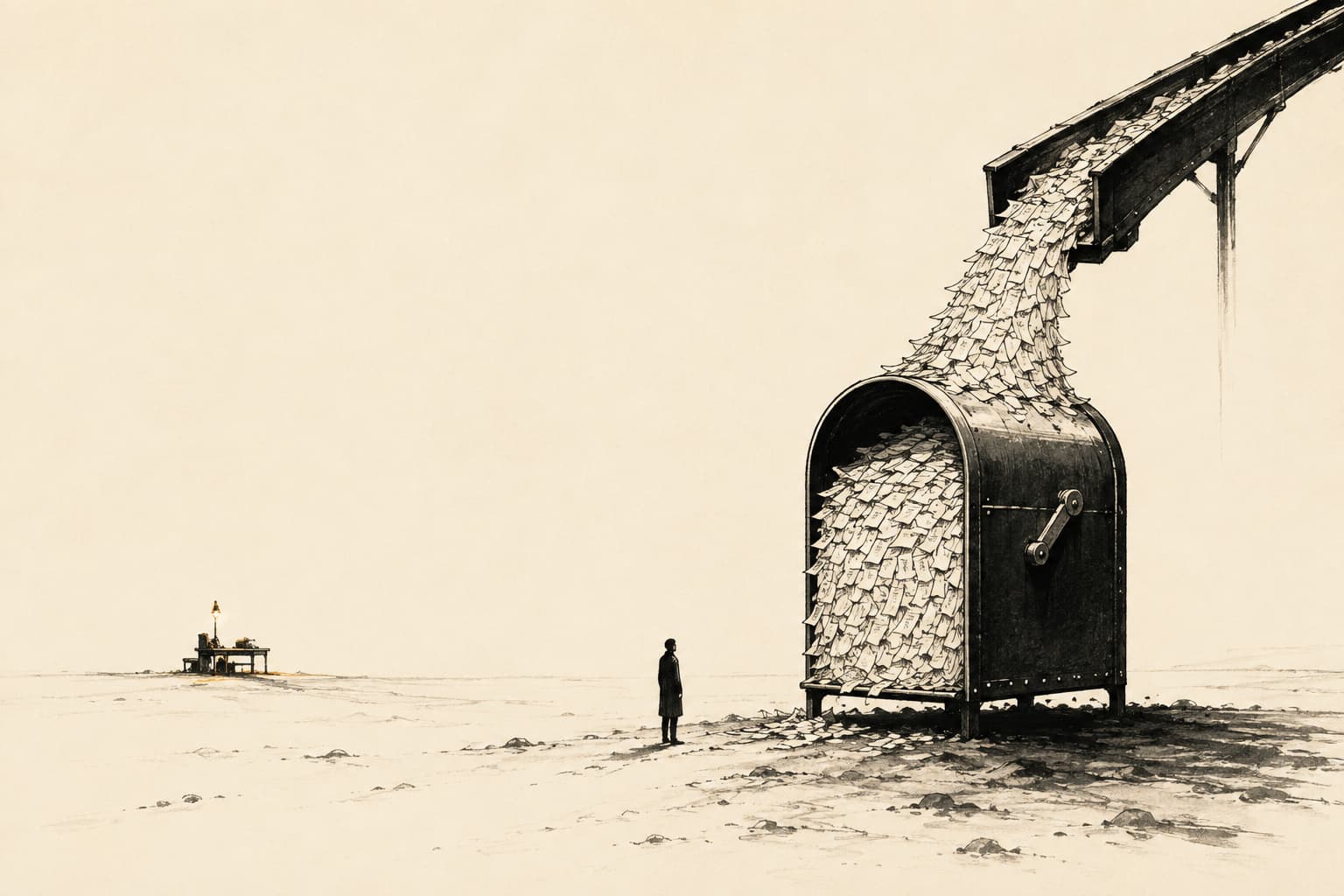
Underneath the beautiful, hand-curated door was the same old plumbing. I would open the feed, scan the titles, and save anything that looked like it deserved better than a thirty-second scan. The feed emptied, but the archive didn’t. The finite, chronological Feedly queue drained straight into the infinite, stagnant reservoir of Instapaper. The finite thing emptied into the infinite thing.
The algorithm hadn’t saved a single one of those 342 articles. I had. My hand-built door wasn’t a replacement for the infinite scroll; it was just a more sophisticated entrance lane to the same pile.
III. The Tarot Healer and the Mesofact
The event that finally made the structural failure visible didn’t happen in a reader. It happened in Eorzea.
I hadn’t logged into Final Fantasy XIV in four years, a game I had previously poured hundreds of hours into. It was released on the Switch 2 on August 4, and I got it during the launch week, which meant playing it on a handheld controller after a decade of muscle memory built on a keyboard and mouse.
The moment I reached the login screen, the background music started. Before I had even touched a button, I felt a physical chill run down my arms. The auditory memory was whole, physical, and instantaneous.
But when my character loaded onto the grid, I looked at my hotbars. I had played a tarot-card healer, a job that required managing a complex rotation of card draws to buff my team’s damage cycles. I stared at the icons. They were dead plastic. The intricate, fast-twitch systems I had mastered over hundreds of hours had evaporated.
The developer had rewritten the job. The tarot healer had stopped gambling with cards, the mechanics had been flattened, and nobody had sent me a letter to warn me.
The cognitive scientist Samuel Arbesman has a term for this: mesofacts. These are pieces of knowledge that don’t change at the speed of the daily news, but don’t remain static across centuries either. They decay slowly over years or decades. If you aren’t paying active attention, you are startled by their quiet expiration.
Four years was long enough for my entire mental model of the game to expire. To re-enter the system, I had to spend hours in the middle of the night reading patch notes, job guides, and forum debates between players arguing over two-minute damage cycles. I did this at eleven at night on exhausting workdays. I didn’t schedule it, and I didn’t wait for a “reading window.” I did it because I had an immediate, physical need to heal a dungeon run the next afternoon.
In my Instapaper archive, I found a parallel graveyard: beautifully written guides for character classes I had previously leveled and played yet never deep enough for any sort of mastery. I couldn’t tell you a single word of any of them.
The difference wasn’t the effort I spent reading them. The difference was that the game guides had stopped asking anything of me the moment I stopped playing. They had no destination.
IV. The Call Flow on the Desk
This realization raised a structural question I should have been able to answer immediately, because answering it is precisely what I do for a living. I have spent my life working to solve problems and document how I fixed them..
When I managed a corporate sales floor, I wrote job aids: call flows, objections checklists, and performance dashboards.
When an agent took a call and reached the pivot point where she needed to pitch a bundle, she would stand up at her desk to flag down floor support. I would walk over, and the job aid would already be open on her desk. She would be actively tracing her dry-erase marker across the plastic laminate, ticking off the columns: How many TVs. HBO. ESPN. Regional sports. ZIP code.
She didn’t go searching for that document when the call arrived. It lived open on the desk because the call was the sole reason the document existed. That is the first class of documentation: continuous-use tools. Something is waiting to consume them at a known, recurring moment. They are the instructions taped to my refrigerator—one explaining that our underpowered microwave requires thirty seconds added to any box instructions, the other explaining how to tell when popcorn is done by counting the gap between pops rather than watching the digital timer.
The second class is the emergency debugging log. In my current role, an overnight payment file will fail to post, a customer will call the next morning in a panic, and the actual technical cause will sit three nested screens away from where anyone would think to look. It happens once a month and confuses a different engineer every time. So, I write it up: what the error looks like, where the cause lives, what to check first. It sits quietly in the knowledge base, waiting for a recurring disaster to pull it back into the light.
Every useful document I have ever written had a clear destination: a human being waiting to be changed by the act of reading it, or a specific, recurring breakdown waiting to pull it into play.
My 342 saved articles were neither. Nothing was waiting for them. No disaster would pull them into service.
We mistake the act of saving for the act of construction. Clicking “save” is not a creative act; it is merely a sophisticated form of procrastination that issues a temporary completion receipt to the brain. A destination is a structural fact of a system, not an emotional state of enthusiasm.
V. The Summoner’s Controller
To see how a document dies without a destination, look at a single piece of writing.
There is a brilliant, exhaustive, free guide to playing a Summoner at maximum level in Final Fantasy XIV. It details the perfect opener, the summon sequences, it’s the perfect rotation of skills to afford maximum damage.
If I click save, it becomes the 343rd item in my archive, and it remains completely worthless to me. Why? Because the guide is written for a keyboard.
On a handheld controller, playing a high-level job is not a matter of pressing “Y” to cast a spell. It is a physical coordination problem: wrapping your fingers around a combination of the left trigger and the D-pad, flipping to a secondary cross-hotbar layer, and maintaining an active thumb-state while dodging a ground AOE.
The sequence of the guide transfers perfectly; the execution does not transfer at all. To make it useful, I have to sit at my desk, open a text file, and translate the keyboard commands into a physical map of my controller’s triggers and face buttons. I have to build an actual physical layout.
The translation is the work. Saving the guide is just collecting a box of gears I have no tools to assemble.
My archive didn’t contain 342 different ideas; it contained one idea 342 times. A recipe for homebrew electrolytes, an investigative profile of a novelist, and an explainer on the Higgs boson were flattened into perfect equivalence by the only attribute my system actually tracked: the fact that I hadn’t read them yet.
When everything is filed under the same generic category of “save for later,” the things themselves stop being different from each other. Something real dies in that simplification.
I still keep Feedly open on my monitor. The software didn’t fail, and I didn’t abandon the open web. But it has stopped being an infinite queue.
I replaced the system with a single, four-second rule: Before I click “save,” I must name its destination.
I must state exactly what problem is waiting to consume it, what physical layout I am building with it, or what project is currently open to receive it. If I have to think about the answer for more than four seconds, I do not save it. I let it go by.
Anything that survives that filter gets read within seven days, because the destination was already waiting before the article arrived.
I never did get Flash working on my iPhone. Eventually, the web stopped asking me to, and the boson got explained to children who hadn’t been born when I clipped the article. The tools were always fine. They just needed me to stop building containers, and start building doors.