
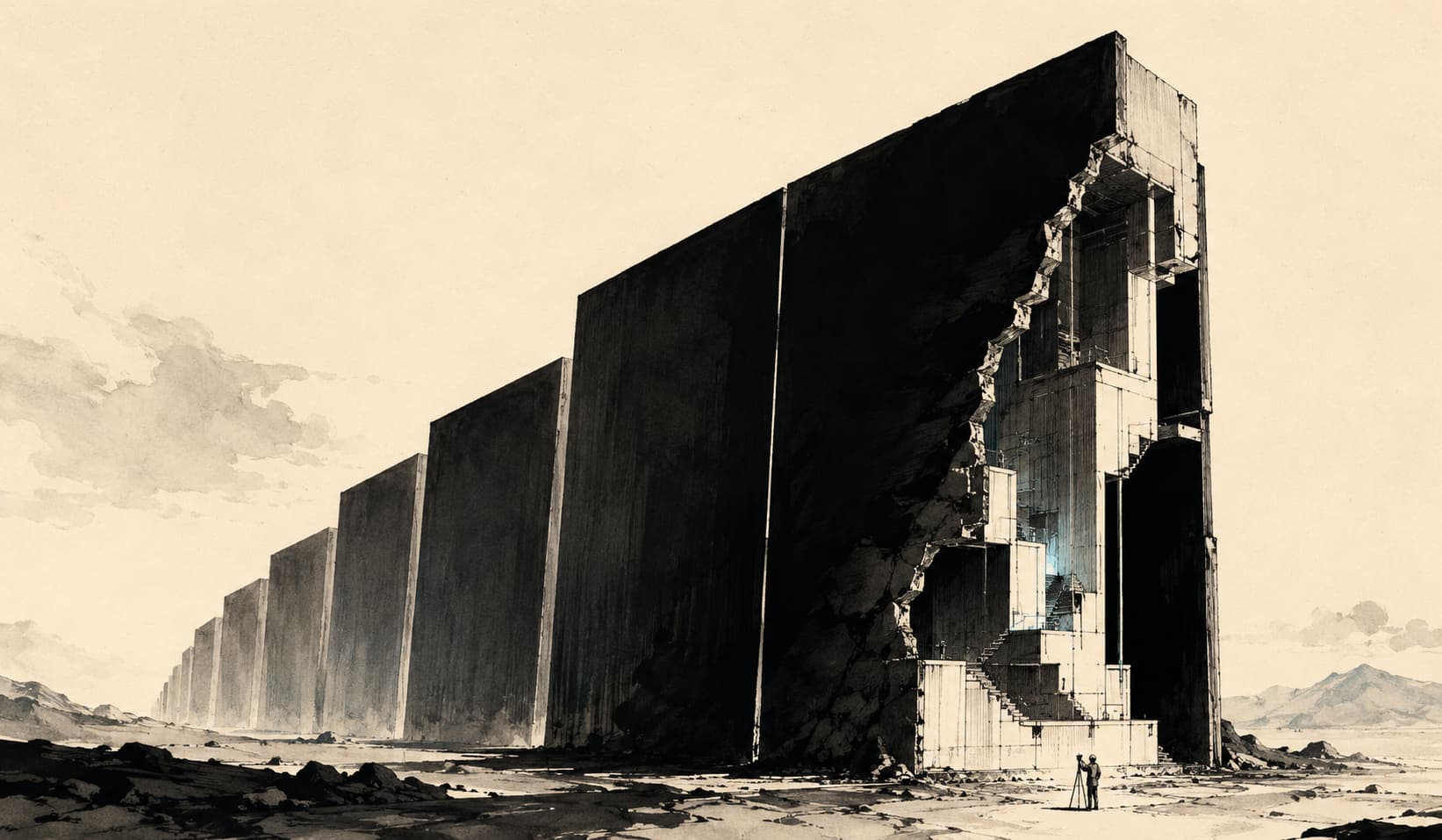
The Class Nobody Had Solved Yet
How the invisible thresholds of a video-game build taught me to see the unwritten rules of a call center—and of everything else
I. The Blueprint Before the Fire
It was midnight on April 28, 2026, and the only light in my room was the cold, blue wash of a progress bar crawling toward one hundred percent. Outside, the neighborhood was asleep, but on the Blizzard servers, fifty thousand people were waiting to cross the threshold into the Lord of Hatred expansion.
When the client finally clicked open, I didn’t jump into the action. I rolled a Warlock, sat back in my chair, and spent the next ninety minutes doing what building a character actually requires: I stared at a blank screen and read upgrade text .
The developer had laid out the nouns of the class—Wrath, Dominance, Abyss damage, and hexes—like loose gears on a workbench. But they hadn’t provided the assembly instructions. It was up to me to figure out what connected them. I took Doom at level one because I wanted the hex tag to multiply my Abyss output, and I spent the rest of the night theory-crafting in a vacuum, watching a patch update slowly download in the background as the rules of the game began to shift under my cursor before I had even cast my first spell.
I made four or five Warlocks builds that season. The first one was mine, a build built around Dread Claws. I chose Cascading Dread over the circular upgrade because I wanted damage stacking on a single target more than I wanted the screen cleared. It was a beautiful, logical concept that failed repeatedly and at high speed the moment I stepped into a high-tier dungeon.
Within a week, nearly every Warlock guide on the internet converged on Dread Claws. There was a slope in the class, and once the community identified the strong interaction, the answer became obvious enough for everyone to copy.
But somebody had to find the slope first.
II. Breakpoints and Staircases
By the second week of the expansion, the build guides existed. They always do.
If you open one of those guides, you will find a highly optimized recipe. It tells you exactly which buttons to press, which gear to equip, and which stats to stack. But it doesn’t always tell you about the staircase underneath the smooth curve.
In the game’s user interface, your stats appear to rise smoothly. You equip a ring that adds three percent attack speed, and the number on your character sheet moves up by three percent. You feel faster, you can feel it early on especially..
But underneath that interface, the game’s animation engine operates on a strict timeline of thirty frames per second. An attack cannot take 14.5 frames; it must take fourteen frames or fifteen frames. This means attack speed has breakpoints. You can add attack speed, watch the number on your character sheet rise, and find that your character executes the attack at the exact same speed as before. The stat rose, but the behavior didn’t. Only when you pile on enough speed to cross a hidden threshold does the animation suddenly jump to the next frame, the breakpoint.
The character sheet displays a slope; the behavior underneath is a staircase.
The game’s developers do not print these staircases on the screen. To find them, players like MacroBioBoi must sit in empty rooms, record their gameplay frame-by-frame, and run the math in public. They isolate single variables, record the results, run them again to eliminate noise, and compare what they observe against what the tooltip claims. They do the arithmetic on camera in the narrow gap between the patch notes going live and the files hitting the servers.
The build guide is merely the answer sheet. The actual expertise happens before the answer sheet is printed.
When I worked in a corporate call center in North Carolina, there was no Maxroll—no central repository where some professional had already solved the system and published the optimal build. We were handed the sheet of numbers and left to navigate the staircase in the dark.
III. Staring into the Forty-One-Column Abyss
I spent six years in that call center—working my way from a headset-wearing agent to floor support, and eventually to team leader.
Every morning, the company published the daily metrics. The report was a massive, unweighted grid of forty-one columns of data, refreshed every twenty-four hours for every agent on the floor. It recorded everything: average handle time, hold time, after-call work, transfer rate, schedule adherence, sales opportunities, close rates, survey scores, and the response rate on those surveys.
The sheet stretched back as far as you cared to scroll, a paralyzing wall of data.
Because human attention is finite, the floor defaulted to watching the three most obvious numbers: customer service scores, sales, and average handle time. Nobody watched their transfer rate. It was just another column in the middle of the sheet, quietly collecting dust.
But the weights of those columns were not published on the daily dashboard. I eventually found them buried deep inside a compensation spreadsheet my supervisor gave me for the month. Buried deep inside was a table of categories with a percentage weight next to each one.
The discovery was staggering: transfer rate counted twice as much as handle time on the monthly scorecard.
I sat down and built a simple filter in Excel. I stripped away thirty-five of the forty-one columns, throwing out everything that didn’t directly contribute to the payout or my agents rankings. I ordered the remaining six columns by their actual mathematical value. What I built was not a sophisticated piece of software; it was a lens that threw away the noise and highlighted the staircase.
I gave the spreadsheet to my team, and we changed how we treated calls. Within two months, my team’s metrics had climbed so high that the team leaders on either side of my cubicle came to my desk, staring at my screen, asking how I was ranking so high and where my numbers were coming from.
They thought I had built a better dashboard. What I had actually built was a model of what the system rewarded.
IV. The Friction in the Membrane
Once you see the weights, the system’s behavior becomes pure arithmetic.
Transferring a call immediately drops your handle time. The moment you click “transfer,” the call ends on your line and becomes someone else’s problem.
This meant the metric everyone was frantic to protect—handle time—was being protected by a behavior (transferring the call) that actively destroyed the customer experience and damaged the metric worth twice as much.
It was an obvious, self-defeating loop. But it was completely invisible on the floor because the two figures lived in separate, unweighted columns. The dashboard displayed contribution, but it completely obscured interaction.
For agents, a short handle time meant easy calls: quick cancellations, balance checks, four minutes and gone. A long handle time meant real troubleshooting. But agents don’t choose their calls; the automated queue does, and call mix is a wave of variance that an agent cannot control. Yet the corporate scorecard treated average handle time not as a variable to be managed, but as a rigid target. If your handle time was too long, you were disqualified from a payout; if it was too short, you were disqualified on suspicion of call-avoidance.
Like a Warlock’s attack speed, the system had hidden boundaries. If you landed outside the window, your payout multiplier dropped to zero.
I didn’t have a name for why these two worlds—the high-level math of action-RPGs and the metric-driven reality of corporate management—felt so identical until I came across a 1983 cognitive psychology study by Mary Gick and Keith Holyoak.
In their paper, Schema Induction and Analogical Transfer, Gick and Holyoak explored how human beings carry a solution from one problem over to a completely different one. They gave participants a story about a general who had to attack a fortress. The roads leading to the fortress were mined; if a large army marched down any single road, the mines would detonate. The general solved the problem by dividing his army into small groups and sending them down multiple roads simultaneously, converging at the fortress at the same moment.
The researchers then presented the participants with a second, analogous problem: a doctor needing to destroy a tumor with a high-intensity ray that would damage healthy tissue if fired at full strength.
To help the participants make the leap, the researchers summarized the general’s story, drew diagrams of the converging lines, and stated the underlying principle out loud. None of it worked. Most people failed to connect the general’s strategy to the doctor’s dilemma.
Then the researchers tried a different approach: they gave the participants two analogous stories and asked them to describe what the two stories had in common.
Suddenly, the light came on. By comparing the two cases, the participants naturally produced the underlying structure—the schema—themselves. The quality of their written comparison predicted exactly how well they solved the tumor problem.
The lesson is profound: being told a rule and being able to see a rule are not the same event. Sometimes, the underlying abstraction becomes visible only when you have a second case to hold it against.
I had spent years believing I was learning six unrelated systems: game design, call routing, scorecard math, Excel scripting, queue management, and corporate operations. In reality, I was practicing a single, repeatable procedure: walking into a system of visible numbers, finding the hidden weights, mapping the unwritten interactions, and building a model to test against what the machine actually pays.
V. Account Bound
In Season 6 of Diablo IV, I played a Necromancer. The Blood Wave skill looked slow and clunky on paper, and I didn’t want to use it.
But my patience was thin that week, so I opened a popular build guide. I allocated my skill points in the exact order the guide specified, farmed the two specific gear pieces it told me to farm, and went to sleep. By the second week of the season, my Necromancer was vaporizing everything on the screen. It was one of the strongest, most efficient characters I had ever played.
But I never actually learned the class. I got the outcome, but I skipped the part where you find the slope.
I had the build, but I didn’t have the skill that produced it.
This is the hidden trade-off of the modern shortcut. A build guide optimizes for immediate performance, and it is spectacularly good at it. But discovery optimizes for understanding. Discovery is slow, frustrating, and routinely produces terrible characters before it produces good ones. Most of the time, we choose performance because we want to see the numbers go up. Our mistake is assuming that borrowing the shortcut is the same thing as possessing the expertise.
In video games, some items are character-bound—they belong only to the character who found them and disappear when the season ends. Other achievements are account-bound—they persist across seasons, across classes, and across updates because they belong to the player.
My call center job ended years ago. The company changed its scorecard, the Excel spreadsheet I built is obsolete, and I couldn’t tell you today what those specific weights were.
But the reflex survived. It is account-bound.
When I am handed a system with numbers in it today, I do not look at the dashboard. I assume the sheet of visible numbers is incomplete, and I go looking for the hidden file with the weights.
The next time you borrow an answer—whether it is a gaming guide, a financial template, an onboarding checklist, or an AI prompt—stop and ask what the creator had to measure to produce it. Ask what they had to discard, what thresholds they crossed, and what relationship isn’t visible in the final recommendation.
By all means, follow the guide. Just don’t confuse holding the map with knowing how the map got drawn.